WHMSPro Blog
Mastering Warehouse Operations for 3PL and E-commerce Fulfillment
Learn how modern warehouse management systems empower 3PL providers and e-commerce businesses with real-time inventory control, efficient order fulfillment, and scalable operations.
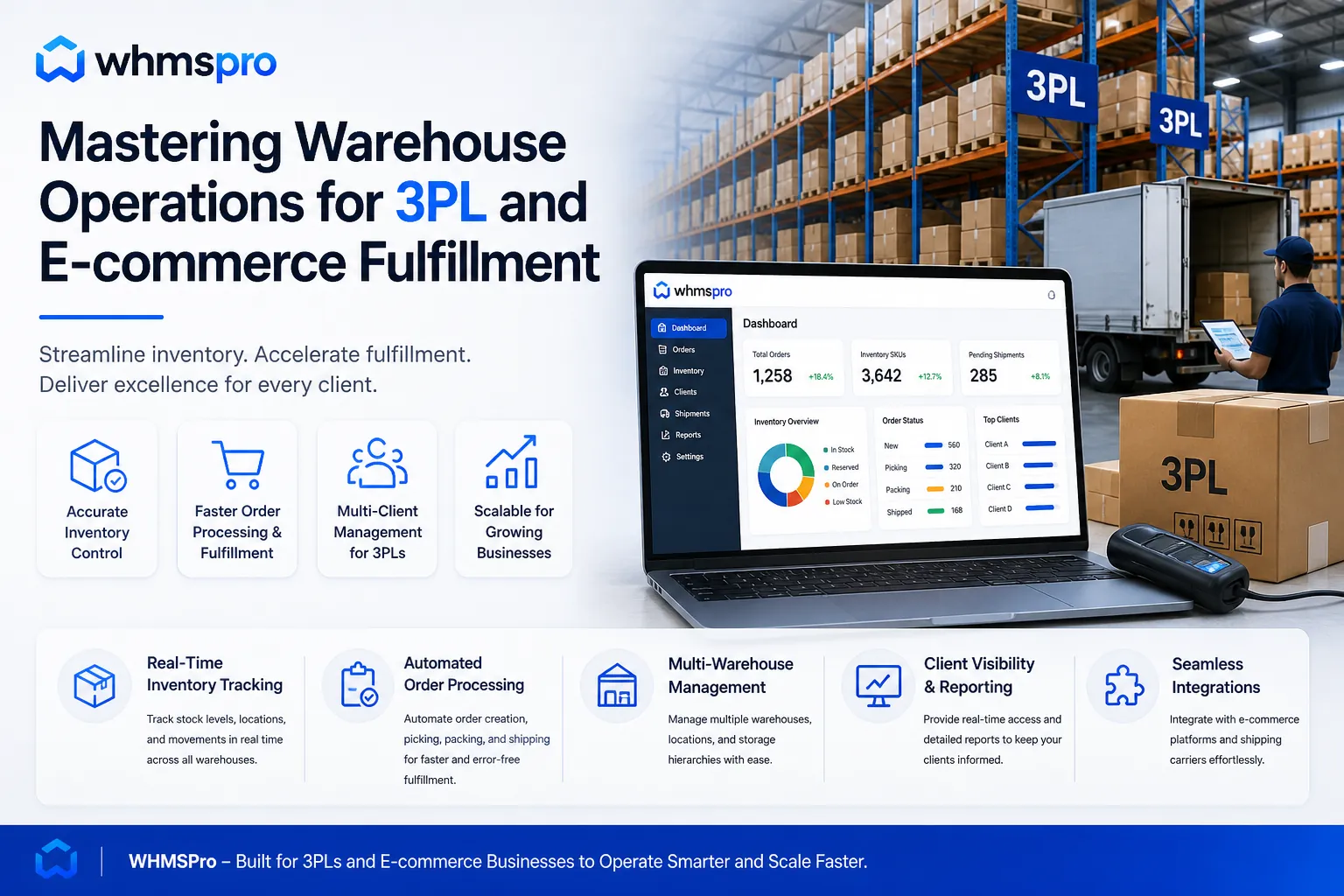
Mastering Warehouse Operations for 3PL and E-commerce Fulfillment
The Evolving Landscape of Modern Warehouse Management
Warehouses today are no longer just storage facilities—they are operational hubs that directly impact delivery speed, accuracy, and customer satisfaction. With the rapid growth of e-commerce and the increasing demand for third-party logistics (3PL) services, warehouse operations have become significantly more complex.
Traditional systems and manual workflows often fail to keep up with these demands, leading to inefficiencies, errors, and higher operational costs. To stay competitive, businesses need a modern warehouse management system (WMS) that provides real-time visibility, structured workflows, and operational control across inventory and order fulfillment.
Core Challenges in E-commerce and 3PL Fulfillment
Both e-commerce businesses and 3PL providers face operational challenges that require speed, accuracy, and scalability. From fluctuating order volumes to managing multiple clients, these challenges demand a system designed for high-performance execution.
Preventing Overselling and Stockouts
Maintaining accurate inventory across multiple sales channels is critical. Without proper control, businesses risk overselling products or missing sales due to stockouts.
A modern WMS ensures real-time inventory updates and automatic stock allocation. As soon as an order is placed, inventory is reserved instantly, ensuring accurate stock levels and preventing discrepancies across platforms.
Streamlining Order Picking and Packing
Efficient order fulfillment is essential for both cost reduction and customer satisfaction. A structured WMS guides warehouse staff through optimized picking routes based on bin locations, reducing errors and saving time.
From single-item orders to bulk shipments, streamlined workflows ensure accurate picking, efficient packing, and faster dispatch—covering the complete order lifecycle.
Managing Seasonal Peaks and Returns
Order volumes can spike dramatically during sales events and festive seasons. Without a scalable system, operations can quickly become chaotic.
A well-designed WMS helps warehouses handle high volumes efficiently while maintaining accuracy. It also simplifies returns processing by enabling quick inspection, restocking, and inventory updates.
Optimizing Operations for 3PL Providers
3PL providers operate in a more complex environment compared to standard warehouses. They must manage inventory for multiple clients, track separate workflows, and maintain transparency across operations.
Multi-Client Inventory Segmentation
A strong WMS allows clear separation of inventory for different clients. Each client’s stock is tracked independently with dedicated storage locations and identifiers.
This ensures:
- No mixing of inventory
- Accurate tracking per client
- Better accountability and reporting
Client Visibility and Reporting
Transparency is a key factor in building trust with clients. A WMS enables 3PL providers to offer real-time access to inventory data, order status, and performance reports.
With detailed dashboards and reporting tools, clients can monitor their operations without constant communication, improving overall efficiency.
Scalability for Growing 3PL Businesses
As 3PL businesses grow, they onboard more clients, expand warehouses, and increase operational complexity.
A scalable WMS supports:
- Multiple warehouses
- Flexible storage structures
- Custom workflows per client
This allows 3PL providers to grow without operational limitations.
Essential Features of a Modern Warehouse Management System
Real-Time Inventory Tracking
Accurate inventory tracking is the backbone of warehouse operations. A WMS provides visibility into stock levels, locations, and movements, ensuring better decision-making and reduced errors.
Barcode and QR-based tracking further improve accuracy and speed in daily operations.
Automated Order Processing
Automation reduces manual work and increases efficiency. Orders can be processed instantly, inventory is allocated automatically, and fulfillment workflows are triggered without delays.
This leads to:
- Faster order processing
- Reduced human errors
- Improved customer satisfaction
Multi-Warehouse and Location Management
Managing multiple warehouses or complex storage layouts requires a structured system.
A WMS enables:
- Multi-level storage organization
- Bin and rack management
- Efficient space utilization
This ensures faster picking and better warehouse organization.
Seamless System Integrations
Integration with e-commerce platforms and order systems ensures smooth data flow between sales and warehouse operations.
This eliminates manual data entry and keeps inventory, orders, and fulfillment in sync across all channels.
Choosing the Right Warehouse Management System for 3PL
Understand Your Operational Needs
Start by identifying your biggest challenges:
- Inventory inaccuracies
- Slow order processing
- Lack of visibility
- Difficulty managing multiple clients
Understanding these pain points helps you select the right solution.
Focus on Scalability and Flexibility
Your WMS should grow with your business. Whether you’re adding new clients, warehouses, or services, the system should adapt without requiring major changes.
Evaluate Support and Implementation
A smooth implementation process is crucial. Look for a solution that offers:
- Easy onboarding
- Reliable customer support
- Minimal disruption to existing workflows
Conclusion
For both e-commerce businesses and 3PL providers, efficient warehouse operations are critical to success. A modern warehouse management system brings structure, visibility, and automation to complex workflows.
By improving inventory accuracy, streamlining order fulfillment, and enabling scalable operations, the right WMS transforms warehouses into high-performance fulfillment centers—ready to meet growing business demands.